2025-05-25
ClimateAI — can novel uses of generative AI help us decarbonise?
GenAI has the potential to solve gigaton-scale climate-decarbonisation problems but is a Faustian bargain — we must avoid diverting from known critical-path levers and focus ClimateAI on high-impact domains while managing its own CO2 footprint.
Intro
It's hard to go a day without a mention of GenAI at work (or honestly even outside work). However, we rarely hear about how this technology can intersect with climate-tech to support decarbonisation — or "ClimateAI". I wanted to examine:
- What exactly are the use cases ClimateAI unlocks?
- How do these compare to big "backbone" challenges in climate-tech?
- What is the cost-benefit between ClimateAI's potential and carbon impact?
1. Use cases vary greatly but the highest impact ones rely on generative capabilities
ClimateAI can cover a broad set of use cases which improve carbon abatement outcomes by applying different types of AI. Most of these provide major uplift in the more fringe parts of the climate ecosystem which are closer to fundamental science and analysis but further from the internals of commercial support. Based on my research, we can group the best applications of AI in climate into three types of problem that it is well suited to help solve:
- Statistical optimisation problems: GenAI provides a user-friendly way to test and improve the application of statistical methods to optimisation problems. A number of these exist in the built environment, industrial heat and logistics sectors. For example, one study found 20–50% energy savings when using AI in climate control systems (Edwards & Bunker, 2023). Also, McKinsey claims that network redesign and route optimisation are the biggest levers to decarbonise logistics and both are clear contenders for the application of AI.
- Large data processing applications: In cases such as weather system modelling, AI is able to radically reduce the computational workload but retain "gold class" performance (Catchay et al, 2024).
- Modelling and generative challenges: In others, such as material science research, generative capabilities are able to completely break new ground on research. DeepMind claim the GNoME model was able to identify over 2.2 million candidate research materials, equivalent to centuries of conventional discovery (Nature, 2023). A 2023 paper by Santos et al claims the use of neural network AI was able to improve wind turbine efficiency almost 20% in a specific use case. Discovering materials for use in carbon capture is yet another similar use.
Rather than going through use cases in detail, it is helpful to review which bucket of uses has the most potential for high-impact carbon abatement.
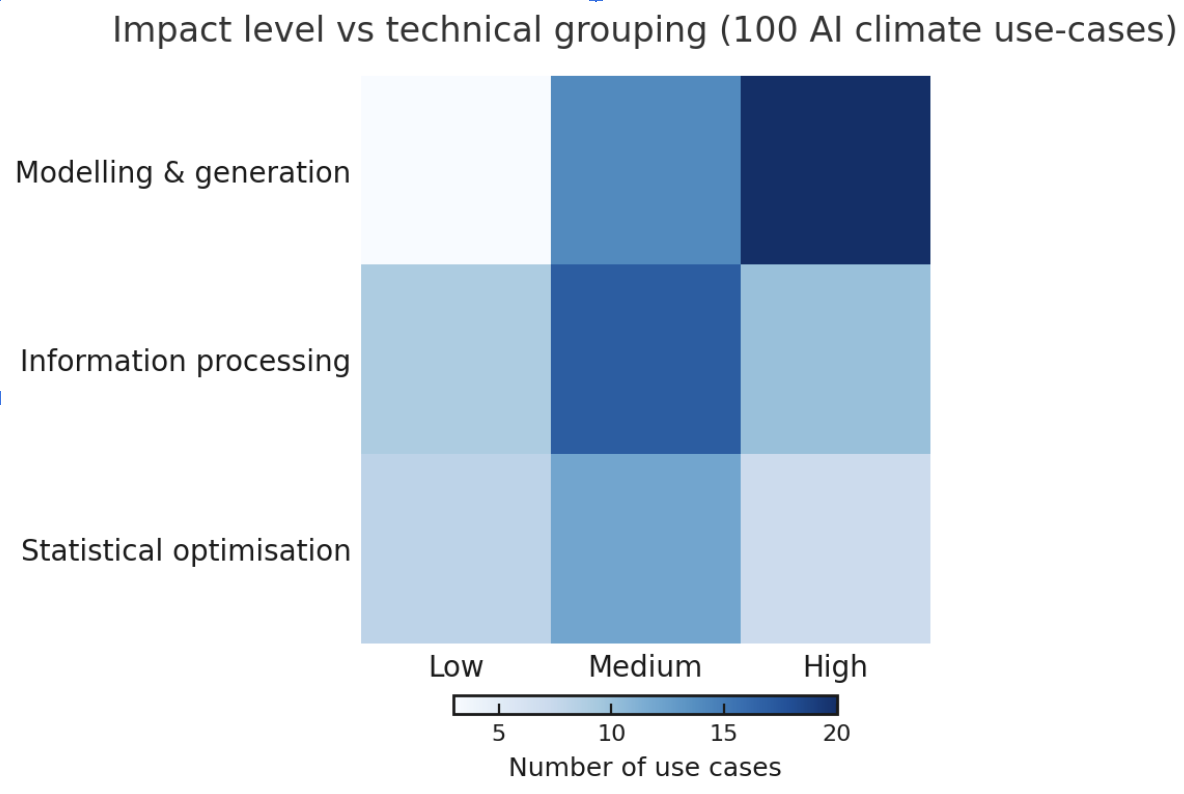 Figure 1 — impact level vs technical grouping across 100 AI climate use-cases; research and analysis supported by ChatGPT.
I would argue that the majority of uses are incremental improvements to existing statistical and computational methods rather than true disruptions. This is not to discount them — something as simple as Greenlight, which uses AI to optimise traffic lights based on Google Maps traffic data, can save 10–20% of emissions at those traffic lights! However, there are pockets to watch which have much higher impact, decarbonisation potential and commercial upside. These high-opportunity use cases are almost all in our "modelling and generative" bucket. Examples that stand out are:
- Advanced materials research in fields such as CCUS chemistry research or perovskite catalysts. Another notable end use of novel chemistries is battery materials. Genuine R&D here has the potential to impact a several $10–100 billion market which is critical for the transition.
- In a very different track, the use of drones for methane leak detection also has a massive abatement potential (in the Gt scale for CO2e). Bridger Photonics uses LiDAR drones to detect, locate, and quantify methane from the gas supply chain — with the clear potential for image recognition AI to accelerate the process.
Where to watch. I would hypothesise based on the above there will be emerging opportunities in:
- Cross-sector information sharing and integration layers facilitating increased data and knowledge sharing between AI teams
- Materials testing, integrity and regulatory adherence capability meeting with AI-enabled robotics to turn materials into reality
- AI climate safety, adaptation and energy efficiency improvements (addressed in part 3).
2. Scaled deployment of maturing, core technologies is more impactful than even the best ClimateAI use cases
Another way to say this is — AI applications in climate-tech are the new shiny thing, but doing the important stuff we know at scale is still the priority. The so-called "backbone" of climate and decarbonisation remains in: large-scale deployment of renewable generation, electrification of previously thermal fuel workloads in industry and transportation, development of low-carbon fuels (including H2) and energy efficiency or carbon capture.
Firstly, it is notable that much of the low/medium impact use cases are those which represent more of an incremental advance on existing approaches — using AI computation to improve analytical methods or process expanded data sources. These use cases go hand in hand with the "backbone" levers rather than replace them. In our data-set of 100 use cases, say we remove the top 5 use cases which have a scale impact of ~1 Gtpa in total; the remaining 95 are estimated to be in the 1.5–2 Gtpa range in total (assuming they are completely additive). Compare this to the 10 Gtpa impact of renewables removing the use of unabated coal (IEA 2023) or 11 Gtpa from doubling energy efficiency efforts (IEA 2023).
Secondly, when we consider the use cases in the optimisation and processing buckets, the majority of these require significant implementation efforts to scale their benefit. E.g., the massive theoretical savings from a smarter heating/cooling solution for buildings requires the implementation effort to retrofit gas boilers to have proceeded — it is pretty hard to optimise a 20-year-old gas boiler with AI!
Thirdly, there is likely double-counting between different use cases we have considered. In optimisation and processing use cases (67% of the total), 20–30% of total potential abatement is potentially double counted (~140 Mtpa). Where multiple use cases address the same baseline (e.g., buildings) we have to apply levers in series so subsequent savings are lower. Further, about 60% of cases require medium-to-high-difficulty implementation, so are uncertain to happen without a very high cost of emitting.
Finally on the bear case: the highest impact 5 use cases, mostly in the "generative" category, still rely on the roll-out of "backbone" decarbonisation infrastructure. E.g., material science research finding innovative battery chemistries still requires us to roll out batteries at enormous scale and build the grid infrastructure to support it. Similarly, CCUS membrane design still requires at-scale adoption of this technology and the sophisticated and well-regulated carbon markets to justify it.
3. The net "return on ClimateAI investment" is fantastic if we capture full potential and manage its systemic climate impact
The elephant in the room, of course, is that the negative climate and environmental externalities of GenAI are both non-trivial and increasing. By 2030 MIT predicts that data centres will use almost 1,000 TWh/y, which is more than Germany and France combined use today. To attempt to resolve this duality, I've tried to create a cost-benefit analysis of the use of GenAI in climate and decarbonisation applications.
Comparing this impact to the noted opportunities above is difficult since these are not apples for apples — but we can conduct a rudimentary comparison of pure emissions effects.
Costs
- Training: training a "last-gen" model such as GPT-3 with ~200B parameters is estimated to require about 1300 MWh of power, emitting about 500 t of CO2 (Wharton 2024). Another source suggested GPT-4 required 52,000–62,000 MWh of power and could output 12,500–15,000 t of CO2 using US data centres.
- Inference: the Wharton authors claim that inference over the life of a model can actually surpass training and account for 60% of lifetime emissions, so we can infer for the whole model inference in the range of 750–22,500 t. Even for a large single use case it is unlikely this will be above the 1–5 t range.
- Other: this does not account for the embodied supply-chain emissions in the equipment itself.
Benefits
Our previous analysis suggests that the high-impact few use cases have an emissions reduction potential of >50 Mt each when deployed at scale. Even though these are fairly ambitious numbers, this suggests each will have a positive "RoAI" even if we allocate the full training costs to these use cases.
In other words, if you believe we can make good on some of these high-impact use cases even to a decent portion of their full potential, it would be worth fully training a new, world-class model just for this — from a pure CO2 cost/benefit perspective.
Without diverting from the purpose of this article too far, I will also note that there are a number of innovations on the horizon which should help reduce the compute required for models significantly, such as model pruning, sparsity, and hardware optimisation, emerging "no training" models, and quantum compute (a whole other article I might save a few years).
Conclusion
Putting this all together — the state of play of AI in climate science is nascent and fairly messy. It is difficult to espouse a strong case since the benefit could be enormous but unrealised while the cost is happening right now.
Overall, there is strong opportunity for ClimateAI to make massive scale impact on climate-tech if we:
- Adopt and operationalise the gains being made in material science, chemistry research, methane detection and optimisation.
- Reduce the computational workload and improve the efficiency of model training and inference.
- Shift AI data centre operators to 100% firmed renewables.
One final use case of GenAI is scaling information processing to help us learn — of course this article was assisted by the use of AI.
Originally published on LinkedIn.